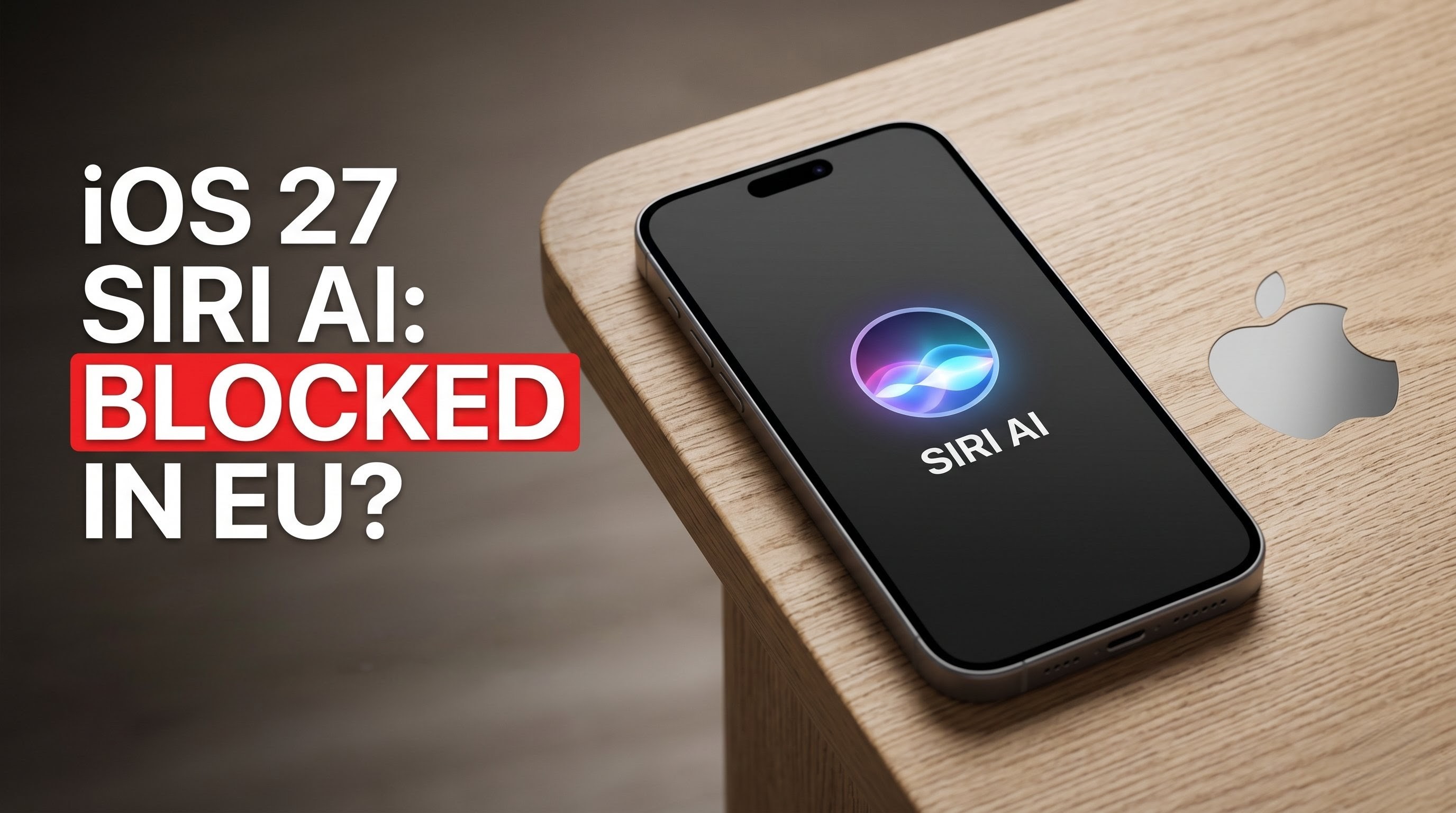
The tech world has been buzzing with excitement ever since Apple officially took the wraps off iOS 27. From massive speed improvements to a slew of customization options, there is a lot to love about the next generation of the iPhone operating system. But without a doubt, the true star of the show was the unveiling of the brand-new Siri AI. After years of feeling like the virtual assistant was lagging behind the competition, Siri has finally received a monumental, artificial intelligence-driven overhaul that promises to change how we interact with our devices.
However, if you are reading this from an iPhone somewhere in the European Union, you might want to hold off on celebrating. In a surprising turn of events, Apple has confirmed that the highly anticipated Siri AI features will not be rolling out to users in the EU alongside the rest of the world. This is a massive blow to European Apple fans, and the reasons behind this delay reveal a fascinating clash between cutting-edge technology, user privacy, and strict government regulations.
Here at Techynoob, we always dive deep into the hardware and software changes that actually impact your daily tech life. So, what exactly is keeping the smartest version of Siri off your iPhone, and when can you expect a fix? The answer lies in a controversial piece of European legislation known as the Digital Markets Act, or the DMA.
To understand the core of the issue, we first need to look at what the new Siri AI actually does. This is not just a simple voice assistant upgrade that answers trivia questions slightly faster. The newly supercharged Siri requires deep, unprecedented access to your user data, your daily habits, and core system functionality. This deep integration is what allows the updated writing tools, the advanced Siri mode in the Camera app, and the contextual awareness features to function so seamlessly. The AI needs to "know" you intricately in order to help you efficiently.
This is where the Digital Markets Act steps in. The DMA was designed by the European Union to ensure fair competition in the digital sector. It heavily regulates companies designated as "gatekeepers"—a label that firmly applies to Apple and its App Store ecosystem. Under the rules of the DMA, if Apple creates a system-level feature that deeply integrates with the operating system, it must theoretically allow third-party developers to offer similar functionality with the exact same level of access.

Apple's argument against this is simple but firm: granting third-party AI providers that same deep level of access to user data compromises the core security and privacy of the iPhone. While Apple can confidently ensure that its own Siri AI processes your personal information securely—often using on-device processing to keep your data out of the cloud—the company states it cannot guarantee the same level of privacy if it is forced to open those identical system-level doors to external companies.
Interestingly, this restriction does not apply to every single Apple product. Siri AI will still be launching on the Mac (alongside the new macOS Golden Gate 27), the Apple Vision Pro, and the Apple Watch in the European Union. Why the sudden exception? The EU does not currently classify these specific platforms under the same strict "gatekeeper" requirements as the iPhone and iPad. This creates a bizarre, fragmented ecosystem where your Mac might be significantly smarter than your iPhone simply because of regional legal definitions.
Behind the scenes, Apple hasn't just been ignoring the European Commission. The company reportedly spent the last several months trying to negotiate a workable compromise. Apple engineers even developed a brand-new software layer dubbed the "Trusted System Agent." This agent was designed specifically to coordinate and monitor access to sensitive user data, acting as a secure bridge that could potentially satisfy both Apple's strict privacy standards and the EU's demand for third-party access.
Unfortunately, those negotiations hit a brick wall. European regulators rejected the Trusted System Agent proposal, bringing the situation to a frustrating impasse. Craig Federighi, Apple's Senior Vice President of Software Engineering, did not mince words when addressing the situation. He expressed deep disappointment that EU users would miss out on these defining iOS 27 features, stating that the regulatory body's refusal to engage constructively on solutions that preserve privacy and security left Apple with no choice but to pull the plug for now. As of today, there is absolutely no timeline for when—or even if—Siri AI will become available on iOS and iPadOS in the EU.
This standoff highlights a growing friction point in the modern tech landscape. On one hand, the European Union is fighting hard to break down walled gardens, ensuring that smaller developers have a fighting chance against mega-corporations. They want a world where you could theoretically replace Siri with a different AI assistant that has the exact same system capabilities. On the other hand, Apple built its entire modern brand on the promise of user privacy and closed-ecosystem security. Forcing them to open up the deepest parts of the operating system is a line they are currently unwilling to cross.
For the everyday smartphone user, this is an incredibly frustrating situation. Technology is supposed to be moving toward a unified global standard, but instead, we are seeing a fragmentation of features based entirely on geography. Until a middle ground is found, EU iPhone users will simply have to watch from the sidelines while the rest of the world experiences the next massive leap in mobile artificial intelligence. We will be keeping a close eye on this developing story here at Techynoob, so stay tuned for updates as Apple and the EU continue their high-stakes game of regulatory chess.
Subscribe to our YouTube channel for daily Android tips, tricks, and tutorials: TechyNoob
Discussion (0)
Post a Comment
No comments yet. Be the first to share your thoughts!